
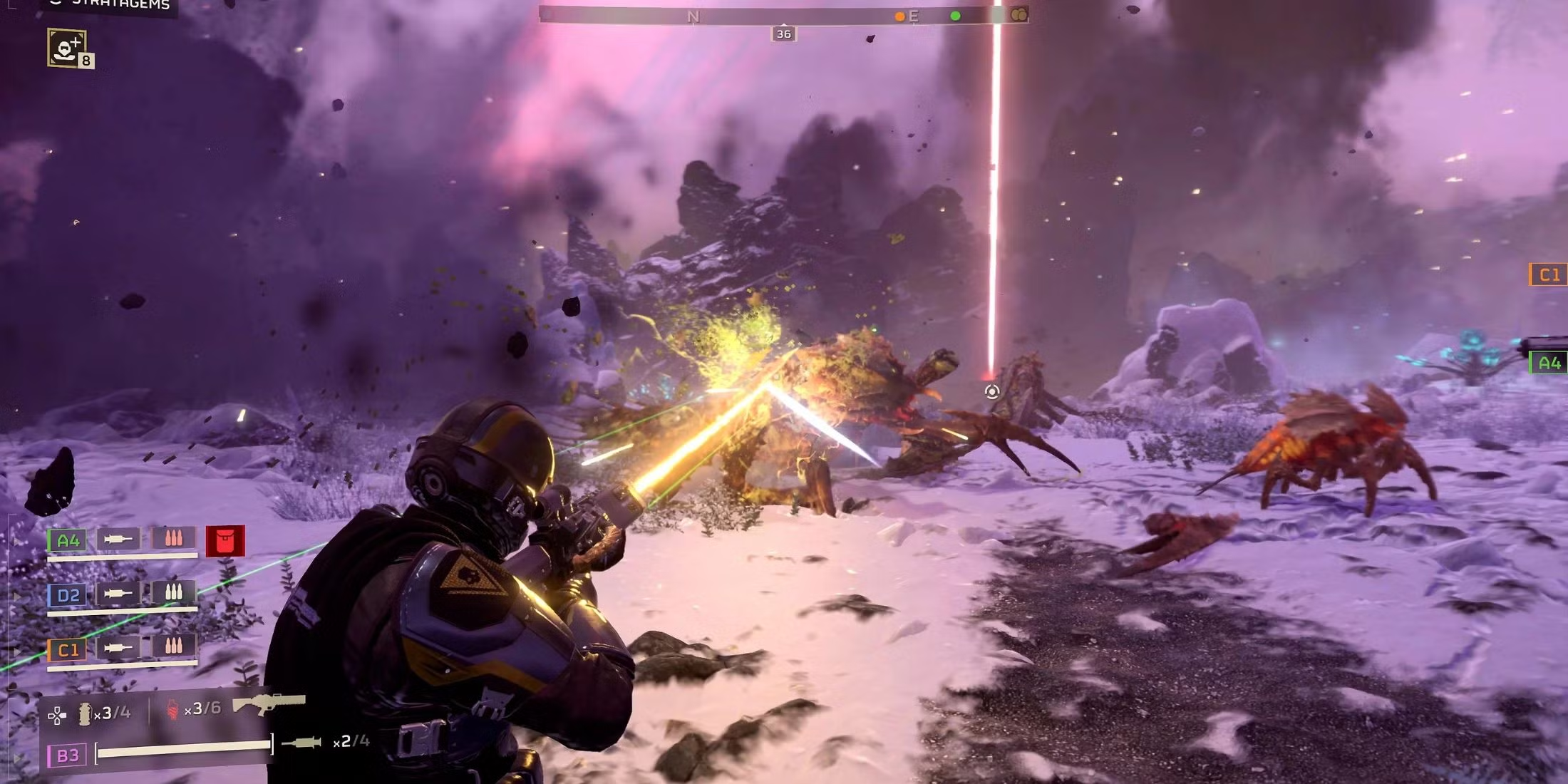
Helldivers 2 is not a shooter where victory comes from reflex alone. Missions are built around pressure—limited reinforcement budgets, escalating enemy density, and objectives that rarely allow mistakes. In this environment, equipment is not decoration. It is the structure that holds a squad together when everything starts collapsing. Players who understand how weapons, stratagems, armor, and support tools interact quickly realize that the difference between extraction and failure is often decided before the drop pod even hits the ground.
Primary weapons define engagement rhythm, and choosing the wrong one can quietly sabotage an entire mission. Assault rifles provide stability across most encounters, offering enough stopping power to thin medium-sized enemy groups while remaining controllable during long fights. Shotguns excel when objectives force squads into tight spaces such as research facilities or communication bunkers, where enemies rush from multiple angles and raw burst damage becomes essential. Marksman rifles reward positioning and discipline; when placed behind teammates running heavier gear, they can eliminate priority threats before those threats destabilize the formation.
Support weapons elevate tactical depth even further. The Autocannon is widely respected because it balances mobility with destructive capability, allowing squads to dismantle armored enemies without becoming stationary targets. However, its true strength appears when teammates understand spacing. A support gunner needs a clear firing lane; otherwise, friendly movement becomes accidental interference. The Recoilless Rifle represents another philosophy entirely—high commitment, high reward. It is slower to operate but devastating against hardened targets, making it invaluable during defense objectives where large enemies attempt to overwhelm fortified positions.
Stratagem selection is where experienced players separate themselves from reactionary ones. Turrets should never be dropped simply because cooldowns are available. Instead, they should shape the battlefield. Placing a sentry slightly off-center from an objective forces enemies into predictable movement paths, which concentrates firepower and reduces squad stress. Shield generators, often underestimated by newer players, create recovery windows during chaotic moments. That temporary safety allows reloads, reinforcement calls, and tactical resets that would otherwise be impossible.
Armor choice quietly determines survivability across long operations. Lightweight armor encourages aggressive repositioning, especially useful during missions requiring constant interaction with terminals scattered across hostile terrain. Heavier armor supports anchor roles—players who intentionally hold ground while teammates complete objectives. Neither approach is universally correct, but squads that deliberately mix mobility and durability tend to recover faster when situations deteriorate.
Progression strongly influences how quickly players can access these tactical layers. Early equipment works, but stronger gear expands strategic options dramatically. Entering higher-difficulty missions with limited tools often forces squads into defensive playstyles, slowing learning and reducing mission success rates. By contrast, stepping onto the battlefield with versatile equipment allows experimentation, which accelerates mastery.
Some players therefore explore reliable marketplaces to shorten that preparation curve. One option frequently discussed is Buy Helldivers 2 Accounts, available through Eznpc. The platform has developed a reputation for secure transactions and comparatively affordable pricing, qualities that matter when account safety is a concern. Rather than feeling risky or complicated, the process is known for being straightforward, allowing players to focus on squad coordination and tactical growth instead of administrative friction.
Better starting resources do not replace skill, but they create space for skill to develop. When equipment supports decision-making instead of limiting it, players begin noticing battlefield patterns—spawn behaviors, terrain advantages, and timing windows that previously blended into chaos. Missions become less about survival and more about controlled execution.
Weather and environmental conditions reinforce the importance of preparation. Snowfields reduce movement efficiency, making stamina-oriented armor more valuable. Dust-heavy maps restrict visibility, increasing reliance on defensive stratagems that can hold territory without perfect sightlines. Urbanized zones reward weapons with manageable recoil, since missed shots often strike cover instead of enemies.
Extraction phases ultimately test whether equipment choices were intelligent. As enemy waves intensify, overlapping stratagem utility becomes critical. A turret buys seconds, a shield extends those seconds, and a well-timed orbital strike resets the battlefield entirely. Squads that plan this layering rarely panic because each tool has already been mentally assigned a role.
Reliability outside the battlefield contributes to confidence within it. Platforms like Eznpc are often appreciated precisely because they emphasize safety and value without excessive promotion. That steady reputation aligns well with a game built on preparation—trustworthy foundations encourage decisive play.
Helldivers 2 rewards foresight. Equipment is not about appearing powerful; it is about ensuring that when pressure peaks, options remain available. Squads that respect this philosophy move differently, fight differently, and extract more consistently.
On the hardest missions, victory rarely belongs to the loudest gun. It belongs to the squad that arrived ready for everything.

 English
 Arabic
 French
 Spanish
 Portuguese
 Turkish
 Dutch
Dutch
 Italiano
 Russian
 Romaian
 Portuguese (Brazil)
 Greek
Greek